Private Press Books: The Art of Fine Printing

Overview
Private press books are defined by their production in small runs, emphasizing handcrafted techniques and artistic vision over commercial viability. Unlike trade editions, private press books prioritize craftsmanship, meticulous attention to typography, and aesthetic quality, making them highly collectible. Collectors are drawn to these volumes for their scarcity, exceptional craftsmanship, and intrinsic beauty, alongside their historical significance within the book arts.
The major movements that shaped private press book-making include the Arts & Crafts movement, which emphasized the handmade quality of books as a reaction against industrial mass production; Art Nouveau, which injected ornate designs; and Modernism, which sought to revolutionize forms and typographical practices.
The private press movement emerged in the late 19th century as a response to the decline in book quality due to industrialization. In 1888, William Morris, a leading figure of the Arts and Crafts movement, established the Kelmscott Press. This press aimed to revive the artistry of bookmaking by producing handcrafted editions with attention to detail and design. Morris's Kelmscott Press became a pioneer in the private press movement, inspiring others to follow suit.
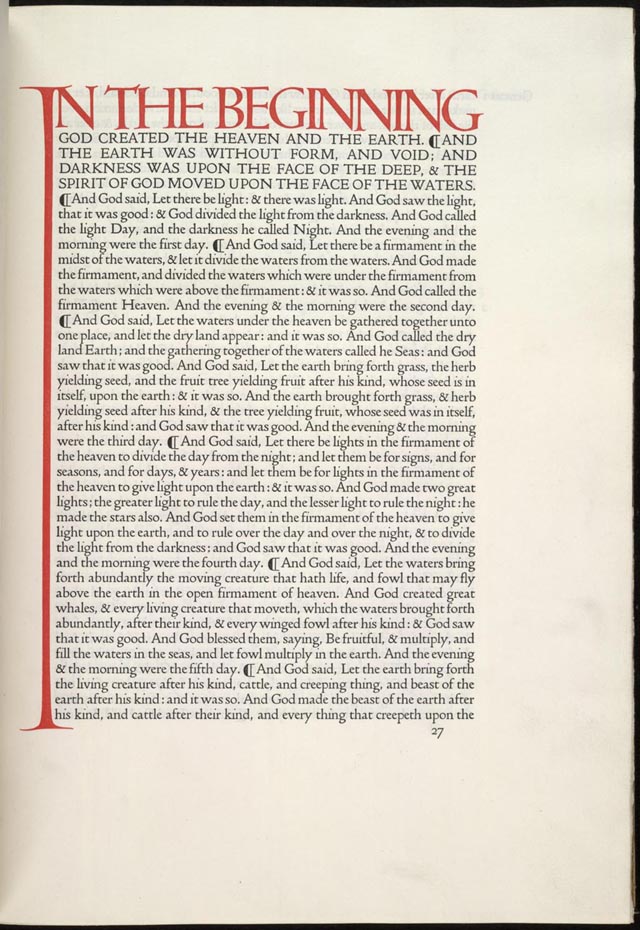
Following Morris's lead, other notable private presses emerged, each contributing uniquely to the movement. The Doves Press, founded by Thomas James Cobden-Sanderson and Emery Walker, produced books with a focus on simplicity and clarity, avoiding ornamentation to highlight the purity of the text. The Ashendene Press, directed by C.H. St. John Hornby, was known for its meticulous craftsmanship and use of handmade paper, producing editions that were both beautiful and functional.
In the United States, the private press movement gained momentum with figures like Bruce Rogers, who worked at Houghton Mifflin's Riverside Press. Rogers applied the ideals of beautifully designed books to commercial production, setting the standard for well-designed books in the early 20th century. His work demonstrated that high-quality book design could be achieved without sacrificing commercial viability.
These movements and individuals collectively contributed to the resurgence of the book as a work of art, emphasizing the importance of design, typography, and craftsmanship in book production. Their efforts have left a lasting impact on the book arts, influencing contemporary book design and production practices.
Historical Context
Historical Context of Private Press Books
The private press movement emerged in the late 19th and early 20th centuries as a response to the mass production of books, emphasizing craftsmanship and artistic design. Influenced by the Arts and Crafts movement, it sought to revive traditional bookmaking techniques and elevate the book to a work of art.
Origins and Influential Presses
In 1891, William Morris founded the Kelmscott Press, marking the inception of the private press movement. Morris, a prominent figure in the Arts and Crafts movement, aimed to produce books that were both beautiful and functional, using high-quality materials and traditional printing methods.
Following Kelmscott, other notable private presses emerged, including:
- The Doves Press (1900–1916): Established by T.J. Cobden-Sanderson and Emery Walker, it produced books with a minimalist design, focusing on the purity of typography and layout. The press is considered to have been a significant contributor to the Arts and Crafts movement, whose founders were associated with William Morris and the Kelmscott Press.
- The Ashendene Press (1895–1935): Founded by St John Hornby, it was renowned for its meticulous craftsmanship and the creation of original typefaces, such as Subiaco and Ptolemy. The press was famous for producing high-quality works by Dante. Ashendene books had excellent bindings and focused more on pleasure than reform than the other private presses of the time, though one review claims that the Ashendene Press was the most successful private press in recapturing the essence of fifteenth-century printing.
- The Nonesuch Press (1922–1966): Founded by Francis Meynell, Vera Mendel, and David Garnett, it produced over 140 books, including a notable edition of John Donne's Love Poems. Nonesuch was unusual among private presses in that it used a small hand press to design books (an Albion press), but had them printed by commercial printers: for example, the Birmingham-based Kynoch Press. The purpose of this method was to produce book designs with the quality of a fine-press but available to a wider audience at lower prices.
Characteristics and Legacy
Private press books are characterized by their use of high-quality materials, such as handmade paper and traditional inks, and often feature specially designed typefaces. They are typically produced in limited editions, with careful attention to typography, layout, and binding. This movement has had a lasting impact on book design, influencing modern printing practices and the appreciation of books as artistic objects.

Key Authors & Works
| Author | Key Titles | Estimated Value (First Edition) | Notes |
|---|---|---|---|
| William Morris | The Works of Geoffrey Chaucer (1896) | £25,000-£100,000+ | Masterpiece of the press, only 425 copies in paper, 13 in vellum. |
| T.J. Cobden-Sanderson | The Doves Bible (1903-1905) | £10,000-£50,000 | Five volumes, the austere type design attracts many collectors. |
| C.H. St. John Hornby | Dante's Divine Comedy (1902) | £8,000-£40,000 | Subscriber-only model, distinctive use of inks make it highly valued. |
| Francis Meynell | The Bible (1926) | £500-£5,000 | Designed for the common reader, collectible for its production quality. |
| Robert Gibbings | The Four Gospels (1931) | £1,000-£10,000 | Noted for wood engravings by Eric Gill, rare and collectible. |
| Charles Ricketts | The Vale Press Editions (1896-1904) | £1,000-£5,000 | Art Nouveau influence with original typefaces make it desirable. |
| Elbert Hubbard | Songs from the Sierras (1896) | £200-£2,000 | Combines Arts & Crafts with commercial printing; collectible yet affordable. |
| George Macy | Various Limited Editions (1929-1970s) | £100-£1,000 | Focus on collectible illustrations, values vary by artist |
Click author names or titles to search on AbeBooks.
Identifying Valuable Editions
Key Elements to Examine
| Element | What to Check | Why It Matters |
|---|---|---|
| Limitation page | Edition size, copy number, signatures | Verifies limited nature; lower numbers often more desirable |
| Colophon | Printing details (typeface, paper, printer) | Authenticates press origins and production standards |
| Binding | Original vs. rebinding | Original publisher's binding preferred; vellum highest |
| Paper | Handmade vs. machine-made | Handmade paper (e.g., Kelmscott, Doves) commands premium |
| Signatures | Author, illustrator, printer signatures | Adds provenance and value |
Condition Standards for Private Press Books
- Fine: as issued, no defects, original binding and slipcase if present
- Near Fine: minimal wear, no restoration
- Very Good: some wear but complete, no major damage
- The market is particularly unforgiving of poor condition due to scarcity.
Red Flags and Reprints
- Many Kelmscott titles were reprinted (e.g., News from Nowhere, 1902 reprint)
- Check the limitation page for edition information
- Beware of facsimiles and modern reproductions
- Verify with standard bibliographies (e.g., Peterson for Kelmscott, Tidcombe for Doves)

Market Trends
Current Demand
- Kelmscott Chaucer remains the trophy, consistently appearing at major auctions. Recent sales include a copy sold for $68,750 at RR Auction in January 2025 and another fetching $115,000 at Bonhams New York in December 2024.
- Doves Press material has seen renewed interest after the Thames type recovery in 2015. The Doves Press Bible, for instance, has achieved £20,000-£50,000 at auctions, reflecting its enduring appeal among collectors.
- Nonesuch Press offers an accessible entry point, with many titles landing under £1,000. This affordability has attracted a new generation of collectors seeking quality at a reasonable price.
- Contemporary presses like Whittington and Arion are gaining recognition among collectors. Their innovative designs and limited editions have contributed to a resurgence in interest for modern fine press books.
Recent Auction Highlights
- Kelmscott Chaucer (vellum copy) sold for over $100,000 at Sotheby's. This sale underscores the sustained high demand for this masterpiece of fine printing.
- Complete sets of Doves Bible (5 volumes) achieve £20,000-£50,000. The Doves Press's meticulous craftsmanship continues to captivate bibliophiles worldwide.
- Golden Cockerel Gospels with Eric Gill’s illustrations consistently strong. These editions remain highly sought after, with recent auctions reflecting their enduring value.
Emerging Areas
- Women printers and presses (e.g., Eragny Press) are gaining recognition. The Eragny Press, founded by Lucien and Esther Pissarro, is celebrated for its artistic and typographic excellence, attracting increasing interest from collectors.
- American private presses beyond Roycroft are emerging. Presses like the Grabhorn Press and the Arion Press are producing limited editions that blend traditional techniques with contemporary design, appealing to modern collectors.
- Mid-century presses (e.g., Stamperia Valdonega) are gaining attention. Known for their innovative use of typography and design, these presses are being rediscovered by collectors interested in 20th-century fine printing.

Glossary
Colophon — A statement at the end of a private press book detailing production: typeface, paper, printer, edition size, and sometimes the press's philosophy.
Limitation page — A page stating the total number of copies printed and the number of this specific copy, often signed by the printer or illustrator.
Handmade paper — Paper made sheet by sheet using a mould and deckle, producing irregular edges (deckle edges) and a distinctive texture.
Typeface — The design of lettering that can include variations in size, weight, and style; critical in book aesthetics.
Fount — A complete set of type of a single design; the term often relates to typography and printing.
Letterpress — A technique of relief printing using movable type; essential to traditional book production.
Wood engraving — A relief printmaking technique using a hard wood block; used for illustrations in private press books.
Vellum — A fine-quality paper made from calfskin or lambskin, often used for high-end editions.
Quarto — A book size created by folding a sheet of paper twice, producing four leaves.
Folio — A larger book format created by folding a sheet of paper once, producing two leaves.
Rubrication — The practice of adding red initials or decorations to printed text; often signifies importance or separates sections.
Initial — A large letter at the beginning of a text or chapter, often elaborately designed in private press editions.
Press mark — A symbol or emblem representing a specific press, often found on the title page or colophon.
Subscriber — A person who agrees to buy a limited edition book, often before its publication.
Prospectus — A document advertising an upcoming publication that includes details and subscription information.
Bibliophile — A person who loves or collects books; especially fine or rare editions.
Further Reading
The Private Press Movement — Victoria and Albert Museum online exhibition (vam.ac.uk)
The Doves Press: A Bibliography by Marianne Tidcombe (2002) — Essential reference for Doves collectors.
A Bibliography of the Kelmscott Press by William S. Peterson (1984) — Standard bibliography for the press.
Matrix (Whittington Press periodical, 1981-2020) — Essential reading for contemporary private press.
Fine Books & Collections Magazine — Regular coverage of private press auctions and news.
The Grolier Club (New York) — Exhibitions and publications on fine printing.
Track Your Collection
Start cataloguing your collection in Biblion today and monitor values as the market evolves.